Golf is one of the hardest sports in the world to dominate, with huge fields each tournament and talented players separated by fine margins.
Many players have competed at the top of the sport for their entire careers but only a handful are seen as greats of the game, for a number of reasons.
The main criteria for a great is somebody who dominated the sport for a sizeable portion of their career, winning multiple times on tour and having the adorning qualification of at least one major title.
It has become harder for the modern player to qualify as a legend of the game, as this term has connotations of a lasting legacy only appreciated once somebody has spent some time out of the sport.
The gulf in quality and smaller field sizes of golf in the early days also led to only a few great players trading majors, while these days there are far more people competing at the top level.
The likes of Jack Nicklaus, Arnold Palmer, Tom Watson and Gary Player were dominant in the 60s through to the 80s, while before that there was Sam Snead and Ben Hogan and even longer ago Harry Vardon and Walter Hagen.
While these players were all greats of the game, the evolution of golf to what it is now suggests the goalposts should be shifted for what quantifies a great in today’s game.
For the sake of narrowing down this article, we will be looking at players from the men’s game who played after the launch of the OWGR in 1986, as ranking systems prior to this were more subjective.
Here is a breakdown of what makes a golfer great and the select few that proudly sit in this category.
Undisputed Greats
There are a few players that nobody would argue don’t deserve the title of ‘great’. Atop this list are Tiger Woods and Nicklaus. Simply put, Nicklaus has amassed more majors than any player, with Woods a close second. Woods’ 82 PGA Tour victories is also a record shared with Snead.
Woods’ influence transcends accolades. He was the face of golf for over a decade, with sponsorships and endorsements flooding in. He had his own series of video games and was on everyone’s bedroom wall because he was winning, and winning in style. His iconic chip-in on the 16th at Augusta not only helped him to Masters glory in 2005 but provided a multimillion-dollar marketing boost for Nike, with the swoosh on his ball exposed for a second before it dropped in.
The work he put in to keep his body in peak physical shape revolutionised the game, and today you can see the impact. Woods was consistently one of the biggest hitters on tour and his success prompted a generation of golfers to take gym work seriously and prioritise swing speed and distance.
His focus and grit were unshakeable too, managing to go from 2002 to 2005 without missing a putt from 3 feet and in, and only once failing to win a major after leading on the final day, when the unassuming Y.E. Yang chased him down at the 2009 PGA Championship.
Multiple Major Winners
A major is the crowning glory for any professional golfer, many through history have managed the feat and a hatful more have done it twice, so can they all be considered great?
There needs to be an element of exclusivity to be considered great. Danny Willett came from nowhere to remarkably win the 2016 Masters, but you would be hard pushed to name him as a great of British golf, never mind of all time.
So, three or more majors seems a solid barometer which few players in the sport have managed. Phil Mickelson, Jordan Spieth, Scottie Scheffler, Rory McIlroy, Brooks Koepka, Vijay Singh, Ernie Els, Nick Faldo, Nick Price and Padraig Harrington all fit the bill.
Each major also poses a differing test, and so winning a variety of titles is seen as even more impressive. McIlroy joined the illustrious Grand Slam club last year, while Spieth, Scheffler and Mickelson are all missing one from the set but show the same versatility.
There is also a debate surrounding the significance of each of the majors, with the Masters perceived by many as the holy grail, while the PGA Championship is often seen as the least ‘desirable’. However, this rhetoric is highly subjective and Bubba Watson’s two Masters titles will therefore not be pitted against Koepka’s five wins (for example).
Longevity & Success
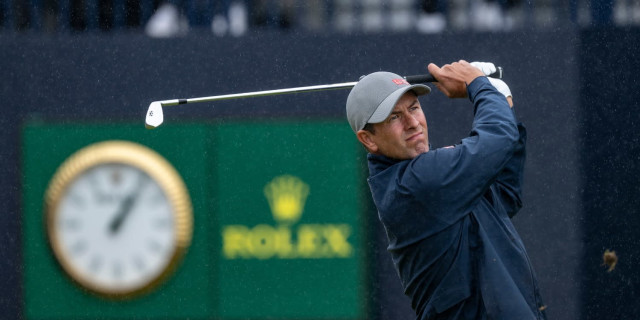
(Image Credit: Rolex/Thomas Lovelock)
Having a long and fruitful career is a solid indicator of greatness. Justin Rose and Adam Scott are the two obvious players in this bracket and both have a major to show for it.
Rose made his debut as a 17-year-old at the 1998 Open Championship where he finished T4, and has operated at the top of the game ever since, winning the US Open in 2013 and a gold medal in the 2016 Rio Olympics. It would not be surprising if a 50-year-old Rosey was still driving around in his kitted out "recovery van" and chasing the lead at the Masters.
Scott, meanwhile, turned professional in 2000 and will make his 100th consecutive major championship appearance at the US Open in 2026. The 2013 Masters champion also has a case for being a great on his buttery swing alone.
Jason Day is another that fits into this category, debuting in 2006 and still playing today with one major to his name, a PGA Championship in 2015.
These three players have a combined 40 PGA Tour victories and have spent a total of 87 weeks as world number one. They continue to compete at the top level of golf. Although not achieving greatness in major victories alone, there is a strong case for stalwarts like these three being perceived as great, or at least on the cusp.
Greats in The Hearts of Fans
This bracket of players is reserved for the cult heroes of the game, whose achievements and popularity have propelled them to a less linear form of greatness.
Ian Poulter always delivered on the Ryder Cup stage and was the catalyst for Europe completing the ‘Miracle at Medinah’ in the 2012 Ryder Cup, cementing his place as a European great. Likewise, Luke Donald who spent 56 weeks as world number one in the early 2010s, will instead be most remembered for leading Europe to back-to-back Ryder Cup victories, with the chance of a three-peat at Adare Manor.
John Daly may be the greatest example of a cult hero. A true maverick who never fit the conventional mould of a professional, whether that be smoking cigarettes and drinking Diet Coke during tournaments or playing rounds severely hung over. Despite this, the Hooters sponsored athlete was not merely a figure of fun and won both a PGA Championship and an Open Championship.
So, there you have it, a breakdown of what makes a golfer great. There are many more names left out who could be considered great and many more who are nearly there, so in a couple of years this article will probably be outdated!