Do you know how far you hit the golf ball? It turns out that most of us probably don’t strike it quite as far as we think we do.
Arccos Golf, the world's largest on-course tracking system and leader in connected AI golf products, has just released the 2026 edition of its Annual Driving Distance Report and there are some surprising findings.
Now in its eighth year, the report draws on more than five million rounds and nearly 10 million driver tee shots from 2025 to deliver an eight-year trend analysis of amateur driving distance and accuracy across age, gender, and handicap.
While the 2026 study draws on a single year of play, the full Arccos dataset now includes over 1.5 billion shots across 25 million rounds played in more than 160 countries.
If you drive the ball 224 yards then you are hitting it the average distance. Of course we all want to hit it further - the closer you can get to a green the less club you have in your hands for your second. But more important than distance is accuracy.
For me, one of the most surprising findings is that the highest handicap golfers end up having to play a recovery or taking a penalty on an astonishing 45% of their tee shots compared with just 12% for low-handicap golfers. In other words, low-handicap players (Scratch-to-4.9) keep their tee shots in play 88% of the time. The rate drops sharply as handicap rises, with 30+ handicap players in a penalty or recovery situation on 45.1% of drives.
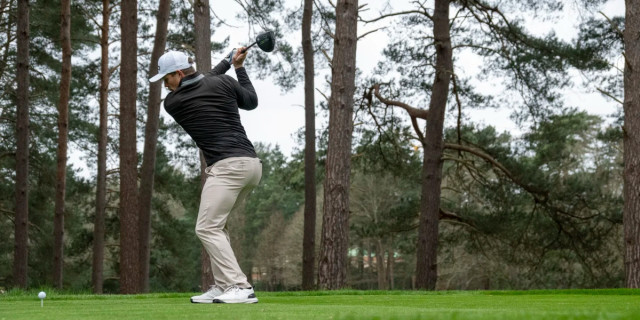
(Image Credit: Kevin Diss Photography)
Surprisingly perhaps, average driving distance for men has increased by less than one yard since 2018, while women’s averages remain within four yards of their original baseline. When you consider all the claims made by golf-club and golf-ball manufacturers that may come as a blow. It makes you wonder if there is actually much point in forking out in excess of £500 for the latest driver because this study conclusively proves that you will not hit the ball any further.
While younger players quite obviously hit the ball further, accuracy improves dramatically with age. The fairways hit percentages climb by 18 points for men and 17 points for women as they move from their 20s into their 70s.
I can definitely confirm that as I have aged I now find more fairways than I ever did in my physical prime. For me, the reason for that is pretty simple - I have finally learnt to consistently swing within myself. I now never swing at more than 80%. And guess what? I find more fairways.
Skill level remains the greatest predictor of power, as shown by a huge 63-yard distance gap between elite amateur men (Scratch-to-4.9) and those with a 30+ handicap.
Environmental factors play a meaningful role in distance, with 10-handicap golfers gaining an average of 19.2 yards (an 8.3% increase) when playing at elevations of 5,000+ feet compared to sea level.
Sal Syed, Arccos CEO and Co-Founder, said: "Better data leads to better decisions, in every part of the game. Our goal is to make sure golfers, coaches, and the industry as a whole have elite-level intelligence on how golf is actually played. That's what eight years of real-world data, at this scale, makes possible."
So the message is clear. If you want to improve, forget about trying to hit the ball into the middle of next week and instead focus on slowing things down and keeping the ball in play.
 X / Twitter
 Instagram