The Masters undeniably ranks among the world's greatest sporting events. It resonates widely beyond just passionate golf fans, your extended network of family and friends will even take notice of what happens, its images are truly iconic, and the library of moments will forever play on a loop through our minds.
But while the patrons gorge on their admirably inexpensively priced sandwiches, the bird song reverberates through those Georgia pines, and the commentators on television breathlessly make sure we don't forget just how special it all is, there is something uneasy that binds everything together.
I am one of those seemingly rare breeds in golf. You could describe me as being a Masters sceptic, albeit a deeply conflicted one.
The Dark History of Augusta National
Once it starts on Thursday and builds towards the anticipation of the back nine on Sunday, I'm as captivated by the drama and consume the sensory feast of Augusta National as feverishly as anyone else. It's my second favourite week on the golfing calendar behind the Open, but that excitement often betrays my own instincts.
Things have gratefully now moved on, but can we overlook the racial and gender discrimination that underpinned this institution for the majority of its existence? That's a dark history that still hangs over the azaleas and those immaculately presented fairways.
Whatever you think of Augusta's modern day reputation and the laudable causes they have backed in recent times (including the Drive, Chip & Putt for juniors, the Augusta National Women's Amateur, and the transformative work undertaken to revitalise Augusta's Municipal Golf Course), it's an uncomfortable reality that an ultra-exclusive golf club, which is closed to the public on 51 weeks of the year, is considered by many to be the pinnacle of this sport.
What does that say about the game?
Give me the highly accessible Old Course at St Andrews and its dog walkers and picnicking families any day over that.
Has The Masters Really Changed?
The edges may have softened at Augusta National, but the legacy of Clifford Roberts, chairman of the club for 45 years and co-founder of the Masters, remains an integral part of the spectacle we relish each springtime, his fingerprints are still visible on the product that we see today.
Described as a "benevolent dictator" by many contemporaries, Roberts masterminded the growth of the Masters with an iron fist, carefully manufacturing the event in his own image.
Roberts sought to control everything related to his club and its tournament. The conduct of members was studiously observed, the enforcement of rules for spectators was strict, while the meticulous glare on words expressed by journalists and broadcasters resulted in more than a few bans through the years.
It's almost half a century since the multi-millionaire investment banker fatally shot himself on the club grounds, but in that regard, the Augusta National of today isn't far removed from how Roberts left it.
Everything is still fiercely controlled. Those who have golden tickets to attend the tournament must not run, they cannot carry mobile phones, and they should behave in a manner befitting the apparent majesty of their surroundings, of course.
Information for spectators declares: "Everyone is requested to display traditional customs of etiquette, proper attire, decorum and behavior, and to obey all Tournament policies, signs and verbal instructions from Tournament officials. Although cheering and positive patron responses to great play are encouraged, unsolicited or consistent calls from the gallery are prohibited. Protests of all types are forbidden."
The Atmosphere is Unique
This is where my internal conflict appears. While I'm dubious of the authoritarian approach taken by the organisers, there is something truly refreshing about the atmosphere of the Masters. Compare that environment to the boorish disgrace that was the Ryder Cup, and the increasingly boozy corporate hospitality culture witnessed at the other big championships, the first major of the year is a welcome throwback.
And these days, when most of us are helplessly addicted to our devices, there is much to be said for seeing a public gathering of many thousands simply living in the moment, taking in the sights and sounds around themselves, without given a thought about how they're going to capture the experience for Instagram.
You also have to like the fact that inside the ropes access is restricted to just the players and their caddies, which is a stark contrast to the entourages who litter the fairways in the other majors.
It's partly how the Masters is able to conjure that delectable blend of being both intimate and grand.
Control is The Key Philosophy
Unlike so many showpieces and bodies in sport, Augusta National's resistance to fully turn on the commercial tap is to be praised too. Regular tournament tickets are still reasonably priced at face value, the food menu, a cliche at this point, is remarkably affordable, and they don't even sell merchandise online, passing up on millions of dollars each year.
You need to be there in attendance to get your hands on that treasured merch, which does create the odd picture of seeing everyone lining the holes wearing branded hats, shirts and three-quarter zips, showing off what they've just purchased.
Perhaps that's another dimension to the philosophy of control. This time it's subliminal. Everyone looks happy, they're present in the moment, all clad in the gear holding their Masters logoed cups or, heaven forbid, carrying one of those ghastly gnomes around with them, demonstrating cultish devotion to the whole thing.
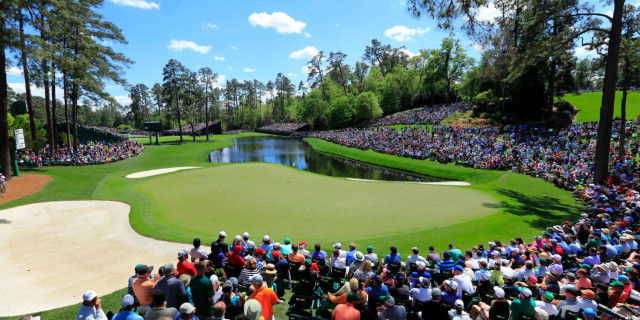
Now that the most cynical exponents within the diminished written press have largely disappeared, the broadcasters have taken even greater prominence in how the tournament presents itself, which is a marriage of convenience as it's also in the interests of those behind TV productions to make everything appear serenely dreamlike too.
Everything Feels Artificial
You'll be hearing a lot of those typical buzzwords. Patrons. Pimento. Magnolia Lane. Amen Corner. Tradition. All said with reverence. There is no rough but a second cut. There are no front or back nines (like every other course in the world) but a first and second nine. It's like a golf version of Pravda, the propaganda newspaper overseen by the Communist Party of the Soviet Union.
There's an artificiality about the messaging that reflects the golf course itself, which is tucked behind a wall of trees just yards from an unattractive main road where, until it closed last year, a Hooters was merely a powerful Rory McIlroy drive away.
Everything is unnaturally perfect. The colours are so uniformly green that you'd almost think that it's a painting - and that's because it literally is. Uncooperative patches of grass are frequently given a touch up to hide even the smallest blemish. The water in its ponds and Rae's Creek is dyed to encourage that shimmering blue. There are theories that even some of the bird sounds you hear are fake.
Augusta National is anything but authentic. It's a projection of our golfing fantasies - and just how reliable and trustworthy are dreams?
But despite all of that, I love the Masters and it might truly be the best event in golf.
I'm not sure what that reveals about me or the game itself, but perhaps like the history of the place and the benevolent authoritarianism that underpins it, for an easier life, it's simpler not to challenge that reality.
 X / Twitter