
The sacred rules that underpin golf to this day were initially written in 1744 by The Gentlemen Golfers of Leith, but, as the USGA states, it was three decades later when the principle that the ball "must be played where it lies" first made a written appearance in the game.
Since those days, it's arguably the fundamental mantra that everything about this sport is built upon, but it doesn't half cause frustration among the many generations of golfers who have followed.
Why do golfers want relief from divots?
When you ask a group of golfers to declare a rule they would like to see added or amended, the most popular response, invariably, will be that you should receive free relief when your ball has landed in a divot on the fairway.
And you can understand why. It's dispiriting and hugely annoying when you've struck a towering, powerful drive to a perfect position on the short grass, only to find that you've landed in the bottom of a divot, which will make your next shot difficult, perhaps impossibly so, to execute in the manner that your tee shot merited.
Golf is about good breaks and bad breaks
It's unfair. Absolutely. But isn't that what golf is about? It's a game of breaks, good and bad, a significant proportion of which won't even be acknowledged during a round.
Some putts will lip into the hole. Others will lip out. You will occasionally suffer a rogue bounce that redirects your ball into a bunker. That was unlucky. Sometimes the opposite happens, where a ball that seemed destined for the sand rebounds away from that fate. That certainly doesn't feel like the deserved outcome.
Your ball may plug in the bunker. Other times it won't. You could hit a ball into the trees that fortuitously meets bark and then finds itself back on the fairway. You didn't deserve that result either. And it's not like you toss the ball back into the forest for the good of your conscious.
Perhaps you've hit the ball into the rough and had the good fortune of finding a playable lie, when just inches away is the deepest stuff that you could only hope to hack forward from on a good day.
The whole point of this is that luck is an everyday part of a round. If you were to start thinking that every shot should be given the fate that it deserves, we'd have to stand on the ball in bunkers or ensure that our wayward drive was buried under the longest grass.
Obviously, that would be nonsensical. And - understandable annoyances aside - the same is true of believing that you should be free to lift your ball from a divot when you have the undoubted misfortune of finding one.
Golf is all about being presented breaks, both positive and negative, and then finding the most effective way to manage that situation.
If you begin to tamper with that reality, then what you are playing ceases to be the game that we've loved for centuries.
Divots are just part of playing golf
Golf courses aren't immaculate carpets. Not even Augusta National. Imperfections exist everywhere to various degrees.
Whereas some damage to a surface will be the result of animals, the impact of storms and bad weather, or as part of greenkeeping maintenance projects, divots are part of playing the game, the natural creation of golfers hitting shots.
You could instruct staff to mark all the divots on a fairway as ground under repair, but that would be a ludicrously impractical and time-consuming endeavour.
You have preferred lies as a possibility, but that's supposed to be a temporary option for the winter months or when conditions are extreme, and generally speaking are in place to protect the course itself.
Where do you draw the line?
Besides, what even is a divot in this exercise, where do you draw the line? Just the fresh ones? What about the ones that are semi-repaired or slowly returning to their previous state? Can you differentiate between all of those and the blemishes that will naturally occur as part of an outdoor arena that is traversed by numerous golfers, all putting strain on the turf, most days of the year, in all manner of conditions?
However, even if you could conjure up a definition that suited everybody and there was a way to sensibly offer relief from divots, why would you even want to?
Why change the fundamental principle of the game?
As noted earlier, if you want guaranteed maximum reward - at all times - from good shots, then you also need to accept the worst possible fate for any bad shots you hit. But as we all know, this is a dynamic sport where outcomes aren't so boringly black or white.
Hitting from divots is just another challenge for you to overcome. Bruce Edwards, the late caddie of five-time Open champion Tom Watson, noted that when his legendary player suffered the bad break of finding a divot, Watson's mindset was to embrace the next shot rather than to bemoan what the golfing gods had inflicted upon him.
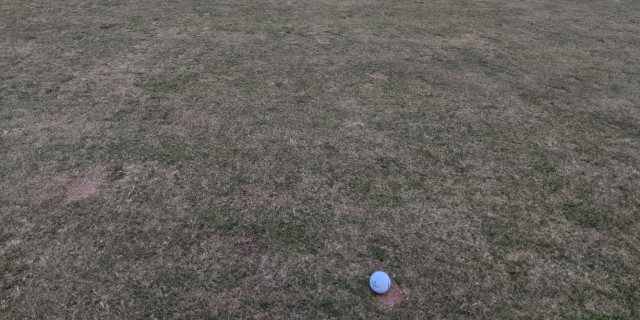
I can recall a time - playing the Old Course just days after the 2022 Open at St Andrews - when I found a divot on the Road Hole after hitting perhaps the best tee shot I ever had on that famous 17th.
There was brief despondency when I got to the ball and found it on a sandy, half-prepared divot, meaning that my odds of getting anywhere near the green with my approach had declined dramatically. But you shake off that sense of dejection and get on with the next task. Just as you should after any disappointing break you encounter on the course.
Play the ball as it lies
I have such a strict adherence to playing the ball as it lies that I only mark my ball on the green when I absolutely have to. Should it not be in the way of another golfer or potentially interfering with play, I will leave it there on the ground, untouched by hand.
That might seem a little daft or overly evangelical when it comes to this principle, but I'm sticking to what I believe is the essence of golf.
I can understand why other golfers feel the way they do about getting relief from divots, but to address that argument, rather than getting into the practical issues of establishing a system of relief, I would focus more on the philosophical question regarding what the game should be about at heart.
You could start handing out free relief from divots, the proponents think it makes perfect sense, but the sport you would be left with wouldn't be golf as it has been or should be.
And I happen to quite like the game as it is. Divots and all.
 X / Twitter