Scotland is the home of golf, where players would once strike pebbles with wooden sticks fashioned by local craftsmen into holes scooped out of the raw turf, each one varying in size.
The sport has become a far more refined practice since the 15th century, but the thrill of seeing a small ball fall into a hole is a rare similarity shared by Gen Zers and medieval Scottish shepherds.
Scotland has kept up with the fast-evolving game but never lost sight of tradition. Courses hundreds of years old have been remastered for the modern golfer but still feel like playing golf in its most pure form.
Championship venues such as St Andrews, Muirfield and Turnberry give Scotland its global prestige, but there are hundreds of hidden gems for a fraction of the price hiding amongst these big hitters.
And the Isle of Arran, aptly nicknamed “Scotland in Miniature”, is perhaps the best value for money golfing experience you can find.
For just £175 you can purchase the Arran Golf Pass, giving you access to one round on each of the seven courses on the island:
That’s £825 less than the cost of one round at Turnberry in peak season.
You can also see below our guide on how to reach Arran and several essential travel tips for your consideration.
Here is a guide to each of the seven courses on the island, and what you can expect.
Shiskine
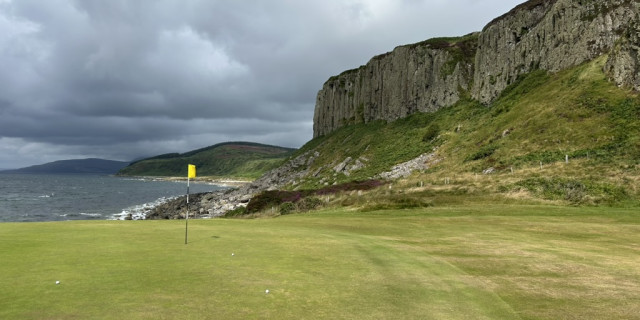
The gem of the island is in the UK top 100 for a reason.
This is a links golf test in its most pure form, virtually every shot is blind, playing over the rolling terrain with wind speeds demanding intuitive club selection.
The stretch from hole three to hole seven will live etched in your memory. The 3rd nicknamed the “Crow’s Nest” is a 137-yard blind par 3 playing up a dramatic cliff face, where landing short will put you in a position similar to Jordan Spieth, when he came tumbling down the hill in the Ryder Cup at Whistling Straits.
Do not also make the mistake of hitting towards the red pin, as this is only to signal the group ahead is off the green, and you will walk up the steep slope only to find your ball 20-yards left of the surface.
The 4th is a par-3 playing from the top of this hill down towards a green with sweeping views of the Firth of Clyde. This was where the wind was at its strongest so astute club selection and a piercing low ball-flight is your best bet.
Hole seven, nicknamed “Himalayas”, has shades of the third, blocked by a large hill with only a spoke at the top indicating the line, it feels like golf’s take on the game Battleships.
It also featured two levers attached by a long piece of rope which you pull to indicate to the group behind when you are off the green.
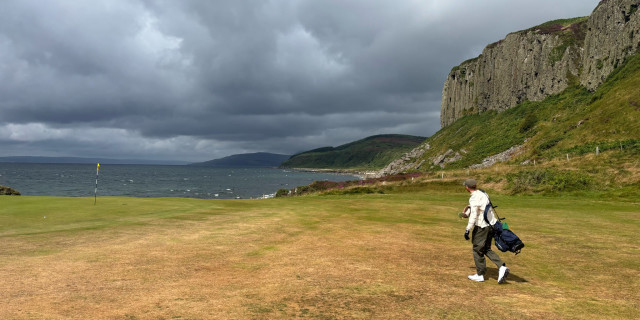
Shiskine is so full of quirks like this, that if it was pitched as a new course to a modern golf architect it would be dismissed as entirely impractical, but that’s what gives it it’s charm.
Without a caddie it feels like riding a tandem solo, and you may be dismayed when you take a drop for a seemingly perfect tee-shot, but you’ll walk off the course with sheer elation from a distinctly unique golfing experience.
Lamlash
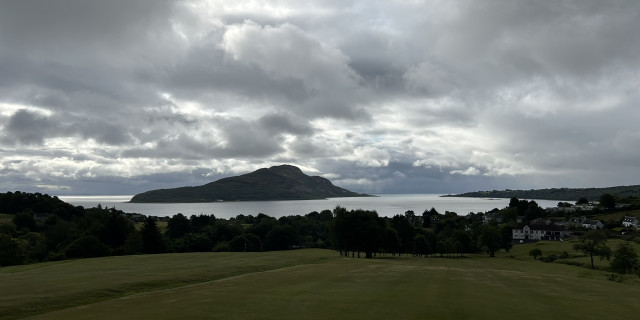
One of three 18-hole courses on the island, Lamlash is a parkland track with plenty of elevation offering serene views across the Firth of Clyde and towards Holy Island.
The course opens with a driver over a valley onto a steep uphill climb, and once you reach the top and are greeted by the views you realise what makes this course special.
You stay on the upper tier until the 5th, a par-3 falling towards a raised green which slopes down to a pair of bunkers, with the hilly backdrop framing a crisp image of your ball as it descends from tee to green.
Lamlash, like the other courses on Arran, is short, but it makes up for it with tight fairways, tiered greens and challenging par-3s, and on the back nine, holes 12, 14, 15 and 17 all measure over 200-yards.
However, it is the easiest par-3 on the course which may be the most fun, measuring only 98-yards and playing downhill, the 16th is appropriately named “Wee Dunt” which is Scottish slang for small knock.
A full lob wedge is plenty to land on the green and it may be your best hole-in-one opportunity on the island, but is no picnic either, with bunkers left and right and the ground falling steeply away.
While parkland golf is not something most people come looking for in Scotland, courses like Lamlash offer a welcome change of pace, a peaceful experience and a break from the blustering winds that can scramble your swing thoughts.
Brodick
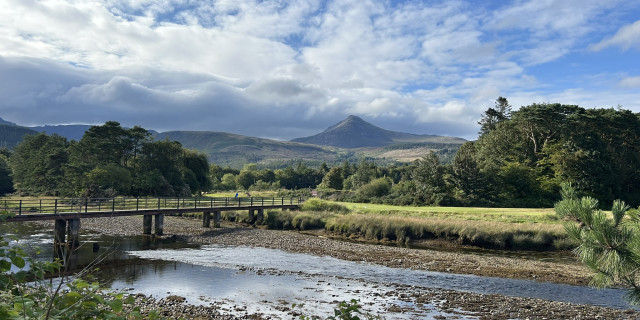
Brodick is the closest course to the ferry terminal so is often the first or last stop on a trip to Arran.
It’s a flat 18-hole layout which is a welcome rest for the legs, while you soak in the views of the Firth of Clyde and Goatfell, the highest point on Arran which looms over the course.
The front nine is slightly inland playing over the river and streams, while locals use the bridal path cutting through the course.
Hole five is where the scenery really starts to work on you with stunning views towards Ben Nuis and Ben Tarsuinn.
It is the hardest hole on the course and one of only two par-5s on the whole island. A 463-yard dog-leg right to left, with a creative second shot needed to shape the ball safely between two large trees.
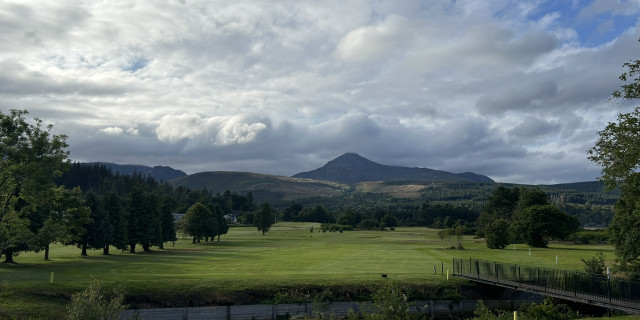
After completing the parkland front nine you transition into a more linksy section of the course, playing right beside the sea with views of Brodick town.
The 12th is a fun challenge, a par-4 measuring only 281-yards feels like a solid birdie opportunity, but the hedge rows 100-yards from the tee box make it a blind shot, and with the wind coming of the sea directly to your left this can feel like an intimidating drive.
Brodick is less about the course and more about the nature surrounding it, providing a welcome break from some of the cardio intensive courses on Arran.
Whiting Bay
This course is not for the faint-hearted. Every review online strongly recommended hiring a buggy, but how bad could it really be?
A proper lung-buster was the answer, but you are rewarded with absolutely spectacular views over the Firth of Clyde and Holy Isle.
Set high above the village on Arran’s south-east coast, the course winds through the natural contours of the hillside, rising steadily before reaching its highest point and beginning the journey home.
Heather, gorse and undulating ground give the course a distinctly natural character, while the changing elevation ensures that no two holes feel quite the same.
While short in length the course bares its teeth in long par 3s, five of which are over 200 yards.
The 13th is the most challenging at 249-yards playing onto a raised green, so take plenty of club, factor in the wind and try to escape with par.
The club itself describes Whiting Bay as a “hidden gem”, and being the only course on the south coast of the island it can be overlooked by golfers travelling to Arran.
More than anything, Whiting Bay captures the spirit of island golf; friendly, unpretentious and wonderfully scenic.
Corrie
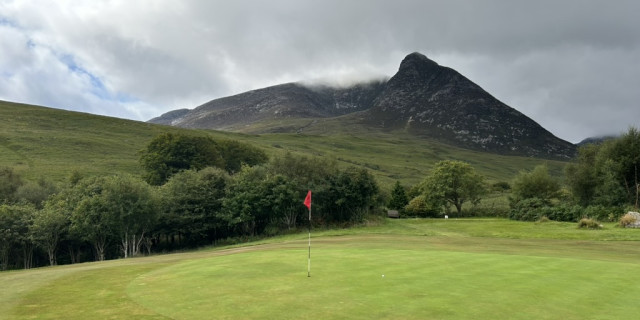
Nestled in the Arran hills and situated just north of its coastal village namesake, this nine-holer is beloved by locals and it’s clear to see why.
Pulling up to the first you are met by a quaint and unassuming forest green clubhouse, with an unattended card machine functioning as a modern-day honesty box.
The first hole is nothing to shout home about but then the course opens up to criss-crossing fairways packed onto the hillside, with close-up views of Glen Sannox.
You will encounter a number of short par-4s measuring from 250-310 yards making the green reachable in one shot. However, the undulating surface, large patches of heather and small greens make for a challenging test.
This is most apparent on holes 3 and 6. The third is referred to by Corrie as “possibly the best view on Arran” and you can understand their hesitation, Arran is not short of amazing views!
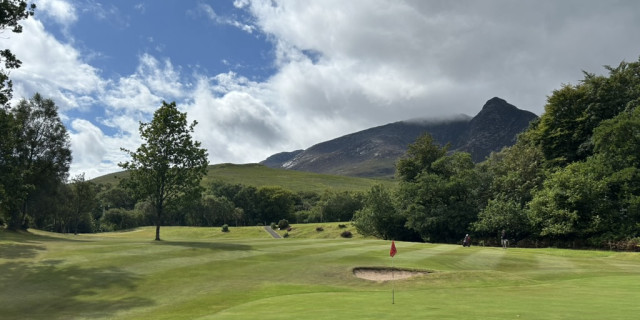
Driving head on towards Glen Sannox, the trees immediately either side and the gully ahead make for an intimidating tee shot, which plays onto a contoured surface surrounded by heather.
The sixth is more challenging, playing across the slope and towards an elevated and sheltered green tucked into the back corner of the course, with certain pin positions leaving you with a finicky chip onto the green.
At Corrie the golf course is not carved into the nature, the nature carves the course, and the small team involved with its upkeep do an immaculate job.
Machrie Bay
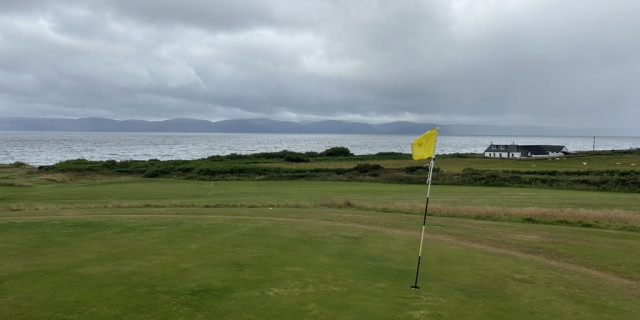
Just a short drive up the west coast from Shiskine is the 9-hole Machrie Bay.
The first few holes feel like you are playing over gardens with patches of fairway separated by lines of hedges.
As first-time players it was also a challenge at first to find the next tee box, but that could be as much incompetence as it is design.
The course then opens up and similarly to Shiskine you are pelted by the gales coming from the unprotected west coast.
Machrie Bay is a relatively flat track so the wind is the main test especially when faced with lofted approaches into the green.
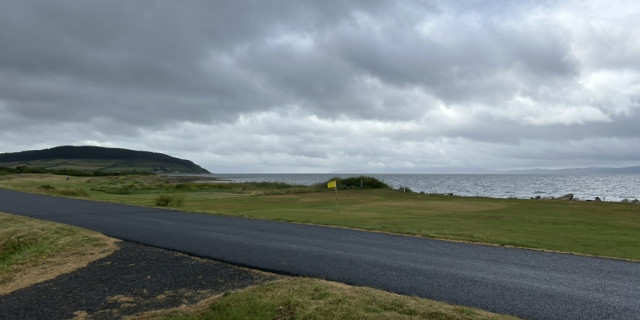
The last hole is without a doubt the highlight while also being a golfer’s nightmare, a tee shot carrying over the main coastal road.
A solid drive (yardage) can get you over in one but a safe layup is nothing to be sneered at. The green is perched right on the coastline and is the only part of the course on the other side of the road.
Lochranza
At Lochranza, the landscape is as much a part of the game as the golf itself. Tucked into the wild beauty of northern Arran, the course unfolds through a broad glen framed by rugged hills.
Nature and golf share the same landscape, red deer often roam freely across the fairways, sheep graze peacefully nearby and you may even catch a glimpse of golden eagles.
The most captivating stretch comes at the aptly named “Sea Field,” around the 6th and 7th holes. Here, the landscape opens towards the water, with sweeping views across the Kilbrannan Sound and towards the ancient 13th-century Lochranza Castle.
This 11-hole par-3 course may be the one to miss if you are short of time, but regardless of playing golf, the north side of the island is well worth a visit.
There is even a small ferry terminal you can take across to the mainland of Kintyre, from where you can then embark on a scenic journey to the likes of Machrihanish and Dunaverty, extending your golfing adventure.
How to Get to Arran & Tips For Planning Your Trip
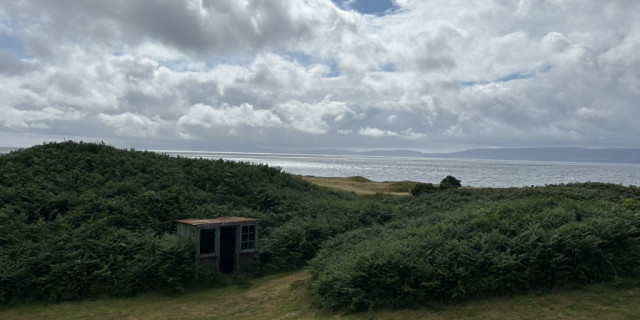
Arran is very small and very popular especially in summer months, so you would be wise to book accommodation nice and early.
CalMac ferries also regularly sell out from Ardrossan and Troon in Ayrshire, so booking at least a few weeks in advance is recommended.
If the ferry times do sell out you also have the option of the ferry to Lochranza from Kintyre (departing at Claonaig), but as this is a smaller boat conditions can occasionally prevent the journey.
The golf pass is excellent value but as are the standard green fees at these courses, so if you find yourself short of time booking individually is still very affordable. Shiskine and the 18-hole courses will set you back just £40, while the 9-holers are priced in the £20 range.
Alternatively, with the pass any courses missed can be played at a later date as it is valid for a year.
It is also important to note that due to popularity Shiskine will need booking in advance, and the golf pass only gives you access to select hours of the day.
The pass can be booked online or organised with Shiskine in advance for collection on the island.
Conditions on the west coast of Scotland are as volatile as it gets and you can experience every wind, rain and sunshine in a single round of golf, so be prepared for anything and embrace the challenge!